
Quick Links
Upcoming
November 10
-Piping Updates to CSA/ANSI/IGSHPA C448 Series: 25
-Projected Design Life of Plastic Piping Used in Geothermal Ground Heat Exchangers
Presented By:
Lance MacNevin, P.Eng.
The Plastics Pipe Institute
The Lunch & Learn program takes place on the second Tuesday of each month, from 11:30 am to 12:30 pm EDT
If you are interested in presenting a topic, please contact us at christine@ny-geo.org
October 13
Valuing GHP Technologies as Grid Assets
Presented By:
Kevin Kitz, P.E. | KitzWorks LLC
Geothermal heat pumps (GHPs) and other geo-exchange technologies have traditionally been viewed by utilities and regulators as primarily a building energy cost-reduction asset. And while “grid value” is acknowledged, it is rarely a significant factor in the decision to install geo-exchange technology. However, the value that GHPs deliver to electric ratepayer customers is far larger than the energy cost reduction to building owners/residents. This misalignment between the beneficiaries (ratepayers) and the investors (building owners) is the largest barrier to greater geo-exchange technology adoption. Interestingly this misalignment is exactly reversed for air-source heat pumps (ASHPs) in which the cost to ratepayers as a whole is far greater than the cost to the building owners/residents.
How can GHPs be one way (ratepayers benefit) and ASHPs the other, when they are both heat pumps? The answer to that question lies in the impact of the two technologies on both winter AND summer peak demand.
The presentation will cover the peak demand impact of GHPs and other geo-exchange technologies, and how it is different from ASHPs. The presentation will explore different methodologies to quantify that benefit and calculate the magnitude of the benefit that all ratepayers derive when large numbers (thousands) of GHPs are installed within a utility service territory. The value to ratepayers of the peaking value alone can be as much as $20,000 per single family home that is converted to GHP for a summer peaking utility with a 4-ton air conditioning load, and even more if the utility is or will be a winter peaking utility.
Some ideas are presented on options for implementing possible incentives and for the QA/QC that ensures that ratepayers get the grid benefits that they would be paying for. Differences between electric customers in ISOs versus vertically integrated utilities will be covered, as well as differences between Investor Owned Utilities (IOUs) and Public Utilities (Muni’s, Co-Ops, etc).
Key Grid Benefits & Value as an Asset
- Utility System Savings: Lower peak loads generate value for electric utilities across generation, transmission, and distribution levels.
- Decarbonization & Load Growth: By reducing overall energy consumption during both heating and cooling seasons, GHPs decrease power generation emissions, supporting grid decarbonization while enabling the integration of large, year-round data center loads.
- Enhanced Grid Asset: Beyond providing significant building-level efficiency and energy cost savings, these combined factors make GHPs exceptionally useful and valuable grid assets. However, measuring the exact scale of these grid benefits has historically posed a challenge.
Presentation Scope & Methodology
- Quantification Frameworks: This presentation outlines three methodologies to quantify the grid value of GHPs and establish appropriate GHP incentive levels.
- Market Structures & QA/QC: It examines how different electricity market models—such as vertically integrated utilities (investor-owned or public) versus Independent System Operator (ISO) delivery regions—affect incentive frameworks and QA/QC processes designed to ensure value delivery.
- Universal Customer Benefits: The session demonstrates how GHP incentives yield long-term rate decreases for all electric customers, including those without a GHP.
- Case Studies: Analysis will include three sample sites spanning diverse climate zones and utility structures.
After registering, you will receive a confirmation email containing information
about joining the meeting.
September 15
Transferable Geothermal Tax Credits
What Buyers Expect Before they Write the Check
NY-GEO Members Walker Blue presented an exceptional panel for our September Program.
Since Section 6418 opened the door to credit transfers, geothermal project owners have been able to sell their Investment Tax Credits to third-party buyers rather than absorb them over years of tax liability. A market has formed around those transactions, and it has matured fast. Buyers and their advisors now run diligence that looks less like a tax review and more like an underwriting file: engineering substantiation, prevailing wage and apprenticeship records, domestic content documentation, tax opinions, and insurance all get examined before anyone commits capital.
This panel walked through a credit transfer from the perspectives of the three disciplines that sit at the center of it.
- David Diaz | Chief Strategy Officer, Walker Blue - Moderator
- John Kapral | Senior Director, Renewable Energy Tax Incentives & Credits, Walker Blue LLC
- Faith Larson | Vice President of Renewables and Legal Counsel, Mickelson & Company
- Corey Lewis | Global Head of Tax Insurance, Brown & Brown
The goal is practical: help project owners understand what a prepared seller looks like, so their transaction closes faster and at better pricing.
Topics the panel discussed:
- How the transferable tax credit market has evolved and where geothermal fits today
- What buyers look for during due diligence, and the gaps that stall deals
- Why engineering substantiation carries more weight with buyers than it used to
- The role of more-likely-than-not tax opinions in a transfer
- Prevailing wage and apprenticeship documentation buyers expect to see
- Domestic content documentation and how it affects credit value
- Where tax credit insurance fits in the transaction and in overall risk management
August 11
AI Readiness: Where Does Your Business Actually Stand?
A practical assessment framework for mid-market companies.
In the sessions Concurrent AI demonstrated how leveraging Agentic AI can drive growth and support the advancement of geothermal projects.
Every board, peer group, and vendor is telling small & mid-market leaders to “do AI.” Very few can say where to start, and the results show it: pilots that impress nobody and quietly die. The problem is rarely the tool. It is readiness. AI amplifies whatever operation it lands in, so clean data, documented processes, and an aligned team get amplified, and silos, tribal knowledge, and manual re-entry get amplified too.
This session walks through an AI Readiness Assessment built for small to mid-market businesses: a 48-dimension, evidence-based scorecard across six pillars covering strategy, data, technology, talent, process, and risk. We look at how the scoring works, what a real scorecard looks like, and how a readiness tier translates into a concrete 240-day path from score to working AI.
Topics Covered:
- Why most mid-market AI pilots quietly die, and what “readiness” actually means
- The six pillars: Strategy & Leadership, Data Readiness, Technology & Infrastructure, Talent & Culture, Process Maturity, and Risk & Ethical AI
- How evidence-based scoring works: 48 dimensions, a 1–4 scale, and five readiness tiers
- A sample scorecard walk-through: reading your own results
- From score to working AI: the Foundation, Pilot, and Expand phases
- What the assessment provides and how to take the next step
- Q&A
Presenter:
David Day
David Day has spent the past decade helping mid-market manufacturers, distributors, and service businesses make sharper technology decisions — fractional CIO leadership, technology assessments, and AI readiness. His work centers on a simple conviction: technology decisions are business decisions, and small & mid-market companies deserve the same decision-grade rigor the large firms sell, without the overhead.
June 9
GREC's
Geothermal Renewable Energy Credits
Renewable Energy Created by Geothermal Installations.
- What are GRECs
- Who do GRECs benefit
- Why are GRECs Important
- GREC Status in Other States
- NYS - Where we are with our GREC legislation
- What are the next steps at the federal and state level?
- How can our members support the initiative?
May 12
GEODesignPRO
A hydraulic modelling tool optimized for fast and accurate calculations vital to successful geothermal system design
Presented by: John Manning
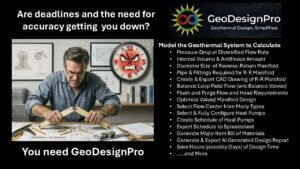
Presentation Deck GeoDesignPro Overview
Presentation Recording HERE
April 21
NY Greenbank
Unlocking Residential Geothermal Through ITC Transferability Bridge Lending
Presented by: Andrea Lee and Sam Bither
NY Green Bank is a division of NYSERDA dedicated to bridging financing gaps and mobilizing capital towards NYS clean energy projects primarily through project finance-style debt. NY Green Bank recently closed its first geothermal transaction, an investment tax credit transferability bridge loan, and are interested in finding additional ways to help fill financing gaps for NYS geothermal deployment. This Lunch n Learn will cover:
- An introduction to NY Green Bank and its investment approach
- Different types of financing available for geothermal
- Background on our recent ITC bridge loan for geothermal heat pumps
- How NY-GEO members should think about assembling a financing proposal
- Q&A
Learn More and Register HERE
After registering, you will receive a confirmation email containing information about joining the meeting.